
1 条题解
-
0
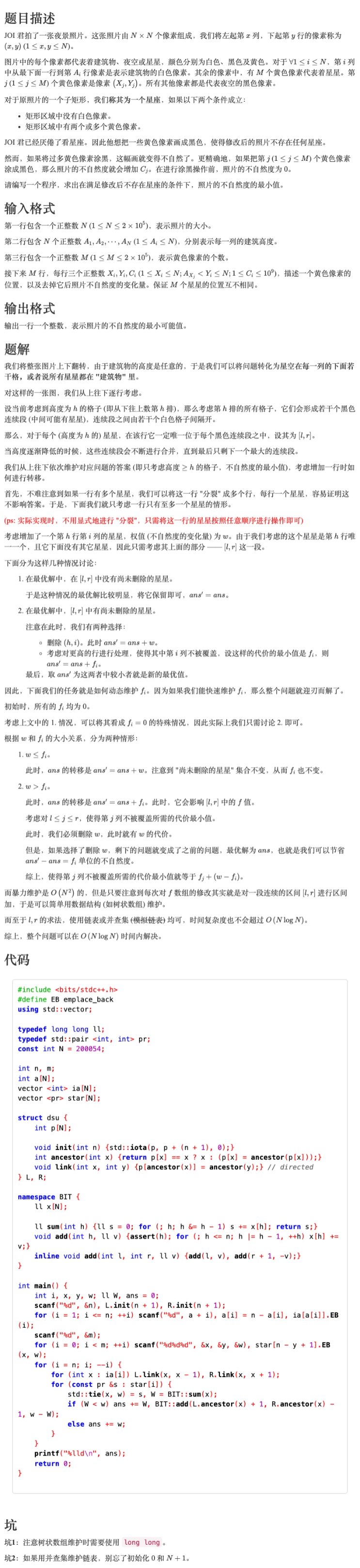
#include <bits/stdc++.h>
#define EB emplace_back
using std::vector;

typedef long long ll;
typedef std::pair <int, int> pr;
const int N = 200054;

int n, m;
int a[N];
vector <int> ia[N];
vector <pr> star[N];

struct dsu {
	int p[N];

	void init(int n) {std::iota(p, p + (n + 1), 0);}
	int ancestor(int x) {return p[x] == x ? x : (p[x] = ancestor(p[x]));}
	void link(int x, int y) {p[ancestor(x)] = ancestor(y);} // directed
} L, R;

namespace BIT {
	ll x[N];

	ll sum(int h) {ll s = 0; for (; h; h &= h - 1) s += x[h]; return s;}
	void add(int h, ll v) {assert(h); for (; h <= n; h |= h - 1, ++h) x[h] += v;}
	inline void add(int l, int r, ll v) {add(l, v), add(r + 1, -v);}
}

int main() {
	int i, x, y, w; ll W, ans = 0;
	scanf("%d", &n), L.init(n + 1), R.init(n + 1);
	for (i = 1; i <= n; ++i) scanf("%d", a + i), a[i] = n - a[i], ia[a[i]].EB(i);
	scanf("%d", &m);
	for (i = 0; i < m; ++i) scanf("%d%d%d", &x, &y, &w), star[n - y + 1].EB(x, w);
	for (i = n; i; --i) {
		for (int x : ia[i]) L.link(x, x - 1), R.link(x, x + 1);
		for (const pr &s : star[i]) {
			std::tie(x, w) = s, W = BIT::sum(x);
			if (W < w) ans += W, BIT::add(L.ancestor(x) + 1, R.ancestor(x) - 1, w - W);
			else ans += w;
		}
	}
	printf("%lld\n", ans);
	return 0;
}
- 1