
2 条题解
-
0
这是一道Catalan+Lucas+乘法逆元+容斥原理の题目
首先我们可以把题意转化为一张图片
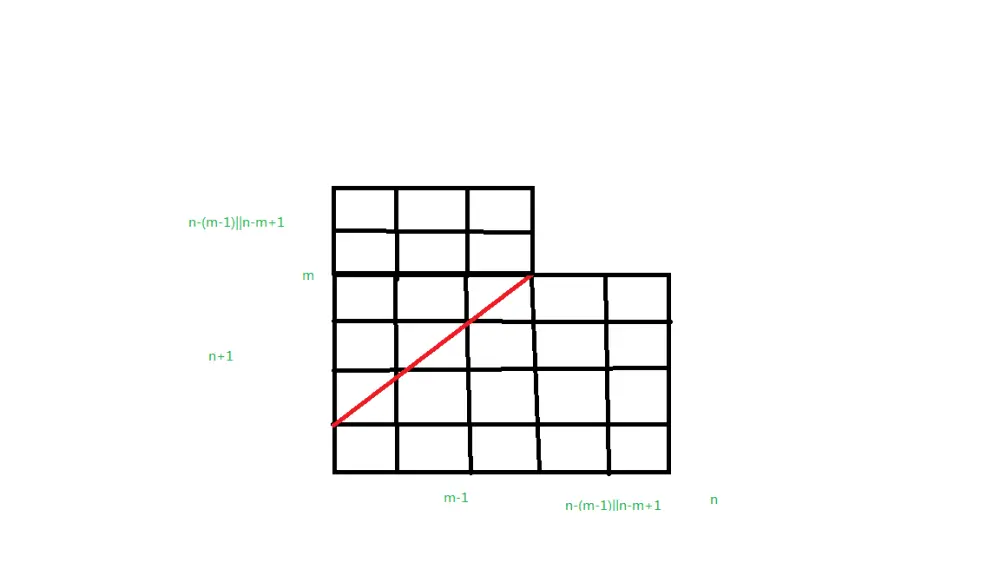
如果我们把向右走看成选择一个 那么向上走就要相应的看成选择一个
那么当我们从 走到 时我们就完成了字符串的生成
那么抛开题目的任意前缀中 的个数必须 的个数の条件
我们计算一下一共有多少种方案数
显然,对于每一步我们都可以向上或向右。
我们一共需要走 步才能到达 且其中 步必须向右
剩余部分(即剩余 )步必须向上
所以总的方案数为 或 (两者相等)
那么原题目的限制条件又怎么处理呢?
我们不难发现只要任一时刻向右走的次数大于等于向上走的次数
就可以判断该情况是否合法
我们可以把每个零界点标出来,即每个
that is 每个点的向上走的次数正好比向右走的次数多一(刚刚跨越条件)
我们把这条直线画出来(图中红线)
只要我们的点不经过红线且能到达点
则该路径生成的字符串一定为合法字符串
我们可以考虑用全部的到达 的方案数减去经过红线但是到达 的方案数
这样就可以求出不经过红线且到达 的方案数了,即为题目所求
我们把经过红线的每条到达 的路径记为
我们可以把每个 经过红线后的部分翻转这样我们走到的终点不是
而是 不懂可以再看看上面图片
那么我们依样画葫芦从点 走到 的方案数就为
或 (两者相等)
那么 =
最后别忘记Lucas和乘法逆元处理取模结果(这里不详细展开了)
code:
#include<iostream> #include<cstdio> using namespace std; typedef long long ll; const ll mod=20100403; ll n,m; ll fpow(ll x,ll y){ ll tot=1,base=x; for(;y;y>>=1){ if((y&1))tot=(tot*base)%mod; base=(base*base)%mod; } return tot%mod; } ll C(int n,int m){ ll sum=1,ni=1; for(int i=1;i<=m;++i){ sum=(sum*(n-i+1))%mod; ni=(ni*i)%mod; } ni=fpow(ni,mod-2); return (sum*ni)%mod; } ll lcs(ll n,ll m){ if(m==0)return 1; return C(n%mod,m%mod)*lcs(n/mod,m/mod)%mod; } int main(){ scanf("%lld%lld",&n,&m); printf("%lld",((lcs(n+m,n)-lcs(n+m,n+1))%mod+mod)%mod); return 0; } -
0
 huangzheng
LV 6
@ 2025-10-8 17:04:46
huangzheng
LV 6
@ 2025-10-8 17:04:46
#include<bits/stdc++.h>
using namespace std;
typedef long long LL;

LL qpow(LL a, LL b, LL p)
{
	LL ans=1;
	for(;b;b>>=1)
	{
		if(b&1)ans=ans*a%p;
		a=a*a%p;
	}
	return ans;
}
LL C(LL n, LL m, LL p)
{
	LL tn=1, tm=1;
	for(int i=1;i<=m;i++)
	{
		tn=tn*(n-i+1)%p;
		tm=tm*i%p;
	}
	return tn*qpow(tm, p-2, p)%p;
}
int main()
{
	LL n, m;scanf("%lld%lld", &n, &m);
	LL p=20100403;
	LL ans=C(n+m, m, p)-C(n+m, m-1, p);
	ans=(ans+p)%p;
	printf("%lld\n", ans);
	return 0;
}
- 1
