
1 条题解
-
0
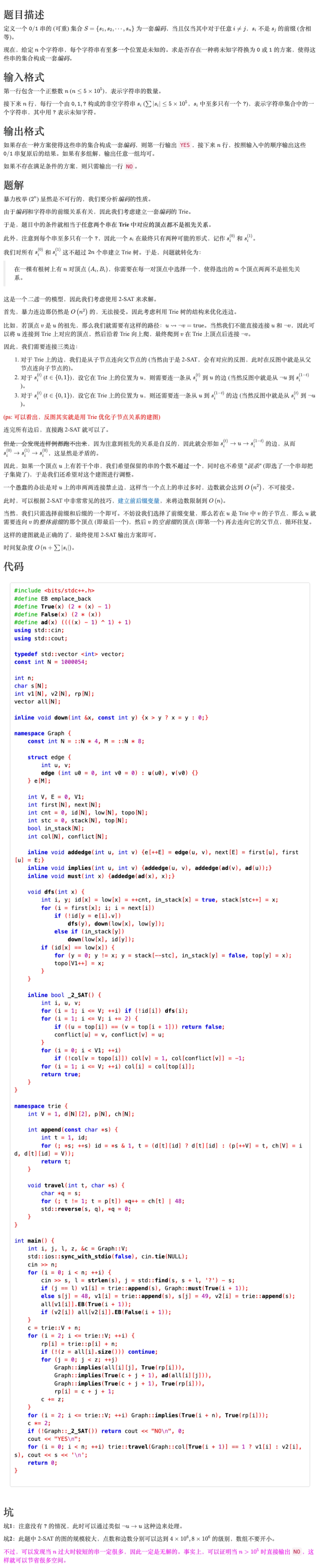
#include <bits/stdc++.h>
#define EB emplace_back
#define True(x) (2 * (x) - 1)
#define False(x) (2 * (x))
#define ad(x) ((((x) - 1) ^ 1) + 1)
using std::cin;
using std::cout;

typedef std::vector <int> vector;
const int N = 1000054;

int n;
char s[N];
int v1[N], v2[N], rp[N];
vector all[N];

inline void down(int &x, const int y) {x > y ? x = y : 0;}

namespace Graph {
	const int N = ::N * 4, M = ::N * 8;

	struct edge {
		int u, v;
		edge (int u0 = 0, int v0 = 0) : u(u0), v(v0) {}
	} e[M];

	int V, E = 0, V1;
	int first[N], next[N];
	int cnt = 0, id[N], low[N], topo[N];
	int stc = 0, stack[N], top[N];
	bool in_stack[N];
	int col[N], conflict[N];

	inline void addedge(int u, int v) {e[++E] = edge(u, v), next[E] = first[u], first[u] = E;}
	inline void implies(int u, int v) {addedge(u, v), addedge(ad(v), ad(u));}
	inline void must(int x) {addedge(ad(x), x);}

	void dfs(int x) {
		int i, y; id[x] = low[x] = ++cnt, in_stack[x] = true, stack[stc++] = x;
		for (i = first[x]; i; i = next[i])
			if (!id[y = e[i].v])
				dfs(y), down(low[x], low[y]);
			else if (in_stack[y])
				down(low[x], id[y]);
		if (id[x] == low[x]) {
			for (y = 0; y != x; y = stack[--stc], in_stack[y] = false, top[y] = x);
			topo[V1++] = x;
		}
	}

	inline bool _2_SAT() {
		int i, u, v;
		for (i = 1; i <= V; ++i) if (!id[i]) dfs(i);
		for (i = 1; i <= V; i += 2) {
			if ((u = top[i]) == (v = top[i + 1])) return false;
			conflict[u] = v, conflict[v] = u;
		}
		for (i = 0; i < V1; ++i)
			if (!col[v = topo[i]]) col[v] = 1, col[conflict[v]] = -1;
		for (i = 1; i <= V; ++i) col[i] = col[top[i]];
		return true;
	}
}

namespace trie {
	int V = 1, d[N][2], p[N], ch[N];

	int append(const char *s) {
		int t = 1, id;
		for (; *s; ++s) id = *s & 1, t = (d[t][id] ? d[t][id] : (p[++V] = t, ch[V] = id, d[t][id] = V));
		return t;
	}

	void travel(int t, char *s) {
		char *q = s;
		for (; t != 1; t = p[t]) *q++ = ch[t] | 48;
		std::reverse(s, q), *q = 0;
	}
}

int main() {
	int i, j, l, z, &c = Graph::V;
	std::ios::sync_with_stdio(false), cin.tie(NULL);
	cin >> n;
	for (i = 0; i < n; ++i) {
		cin >> s, l = strlen(s), j = std::find(s, s + l, '?') - s;
		if (j == l) v1[i] = trie::append(s), Graph::must(True(i + 1));
		else s[j] = 48, v1[i] = trie::append(s), s[j] = 49, v2[i] = trie::append(s);
		all[v1[i]].EB(True(i + 1));
		if (v2[i]) all[v2[i]].EB(False(i + 1));
	}
	c = trie::V + n;
	for (i = 2; i <= trie::V; ++i) {
		rp[i] = trie::p[i] + n;
		if (!(z = all[i].size())) continue;
		for (j = 0; j < z; ++j)
			Graph::implies(all[i][j], True(rp[i])),
			Graph::implies(True(c + j + 1), ad(all[i][j])),
			Graph::implies(True(c + j + 1), True(rp[i])),
			rp[i] = c + j + 1;
		c += z;
	}
	for (i = 2; i <= trie::V; ++i) Graph::implies(True(i + n), True(rp[i]));
	c *= 2;
	if (!Graph::_2_SAT()) return cout << "NO\n", 0;
	cout << "YES\n";
	for (i = 0; i < n; ++i) trie::travel(Graph::col[True(i + 1)] == 1 ? v1[i] : v2[i], s), cout << s << '\n';
	return 0;
}
- 1
